

I’m on sick leave this week, but I have a few projects I can’t completely put aside. I’m mostly replying to clients’ messages, reviewing apartment photos, and looking for new properties that could be interesting for future projects. Since I’m not used to working from home, I settled onto the couch with my laptop on the first day and decided I didn’t need a desk at all.
After just a few hours, my back started hurting, and I noticed that I kept changing positions because none of them felt comfortable for more than twenty minutes. That’s when I decided to find out what ergonomics experts think about working from the couch.
Is working from the couch really that bad? Occasional work isn’t necessarily a problem, but experts generally don’t recommend spending an entire workday on the couch. How you sit and where you position your laptop are particularly important. Regular breaks are also essential, even if you have a high-quality office chair.
Here’s what I discovered about the subject between replies to emails:
- Working from the couch occasionally isn’t a problem, but experts recommend a desk and a suitable office chair for longer work sessions.
- Using a laptop on your lap can cause neck and shoulder pain. A laptop stand and a separate keyboard allow you to maintain a better posture while working.
- Change your position every thirty minutes. Even proper sitting posture can’t replace regular breaks and short walks.
- If you have to work from the couch, make sure your back is supported. Use a firmer cushion and keep your feet flat on the floor.
- You don’t need a separate room for a small home office. All you need is a suitable desk and an adjustable chair, along with good lighting.
Your Laptop Can Be a Bigger Problem Than You Expect
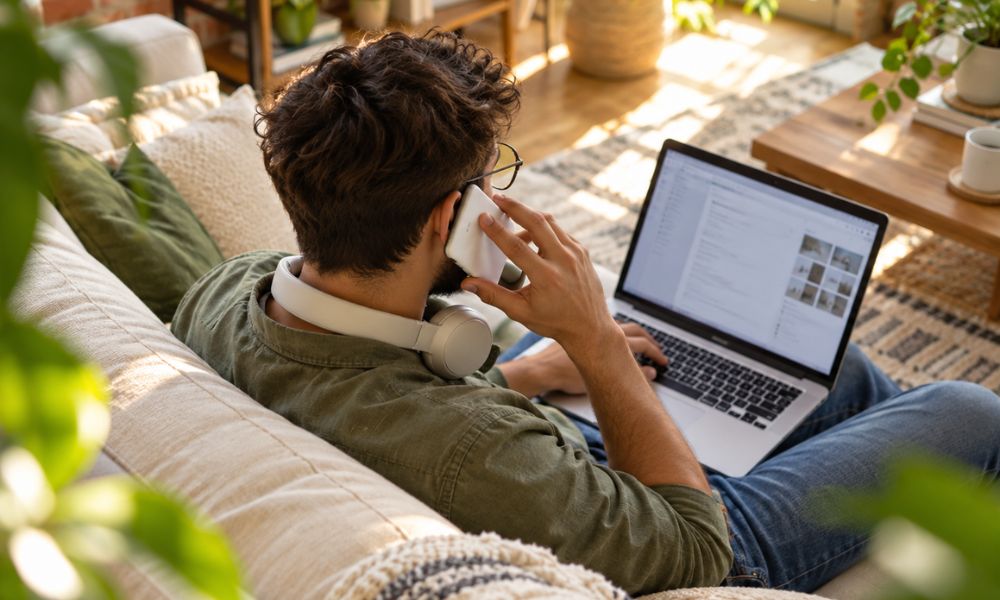
In one of my favorite publications, BU Today, I read ten ergonomic tips from Boston University experts, which specifically warn about prolonged laptop use. A low screen often forces us to bend our necks, which can cause neck and shoulder pain. That’s why they recommend a separate keyboard and a laptop stand to keep the screen at approximately eye level.
I spent most of my time trying to find a comfortable position for my laptop. If I keep it on my lap, I have to lower my head to see the screen. When I raise it on a cushion, my arms are no longer in a comfortable position for typing.
If I had to work on a laptop every day, I’d first get a suitable stand and a separate keyboard. Still, for several hours of typing, I’d rather use a regular desk.
Is There One Correct Sitting Position?
I found a comment by Kermit Davis about working from the couch, a professor at the University of Cincinnati, particularly interesting. In an article about working-from-home ergonomics, he explained that the body doesn’t like staying in the same position for long periods. He recommends changing positions and taking breaks approximately every thirty minutes.
Davis and his colleagues studied working-from-home conditions during the pandemic. After conducting ergonomic assessments of 41 home workstations, they found that 73% of the workstations they examined lacked adequate lower back support. Many employees also had their monitors positioned too low.
I’m now trying to get up after completing each task. Sometimes I walk around the apartment during phone calls with clients. That routine currently works much better for me than constantly trying to find the perfect position on the couch.
Does That Mean You Should Give Up Working From the Couch Completely?
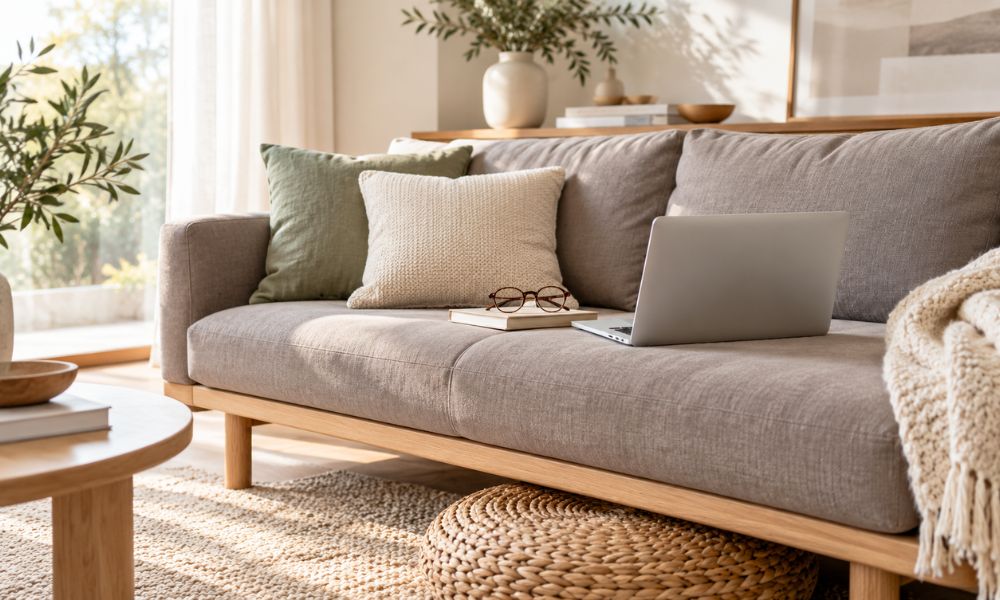
I don’t think you need to avoid the couch altogether. It works perfectly well for me when I need to read a few emails or review photos of a new project. However, experts distinguish between occasional work and spending eight hours on the couch.
For example, experts at Syracuse University recommend using a suitable chair and a flat work surface for longer work sessions. They pay particular attention to back support and the ability to keep your feet flat on the floor.
If you currently have no other option, try using a firmer cushion to support your lower back. A stable laptop stand can also be useful. However, avoid spending several hours in a semi-reclined position with your laptop on your stomach.
How I’d Set Up a Small Home Office
Since I’ve spent the last few days reading about ergonomics and working from the couch, I’ve decided to return to an area I know much better.
While working on apartment interiors in Los Angeles, I’ve often had to find space for a home office, even when the owners didn’t have a separate room.
If you’re also planning to set up a small home office, here are a few solutions I’d consider:
- Choose a desk with sufficient depth. You don’t need to buy a large desk, but you should have enough space for your monitor. Before buying one, check how much room you’ll have left for your keyboard.
- Place your desk near a window. I prefer a position where natural light comes from the side. That way, I can avoid direct glare on the screen. For evening work, I’d add an adjustable desk lamp.
- Make use of part of your bedroom. If you don’t have a separate office, a small desk can replace one of your nightstands. Before you do that, read how to protect your sleep when your bedroom is also your office. I also like IKEA’s ideas for a hidden workspace, especially the idea of separating your office with a curtain that you can close at the end of the workday.
- Don’t skimp on your office chair. For everyday work, I’d first look for a model with proper back support. Being able to adjust the chair’s height correctly is much more important to me than having it perfectly match the rest of the furniture.
- Hide cables and unnecessary equipment. In small apartments, I try to preserve as much free space as possible. One closed shelf can be enough for documents, and you can organize cables underneath your desk.
Will I Continue Working From the Couch?
I probably will, but only when I need to finish a few simple tasks. Right now, getting up occasionally and changing where I work suits me best, especially when sitting starts to feel uncomfortable.
After a week of working from the couch, I think that’s a perfectly reasonable compromise. I’d still rather save the couch for relaxing after work.