
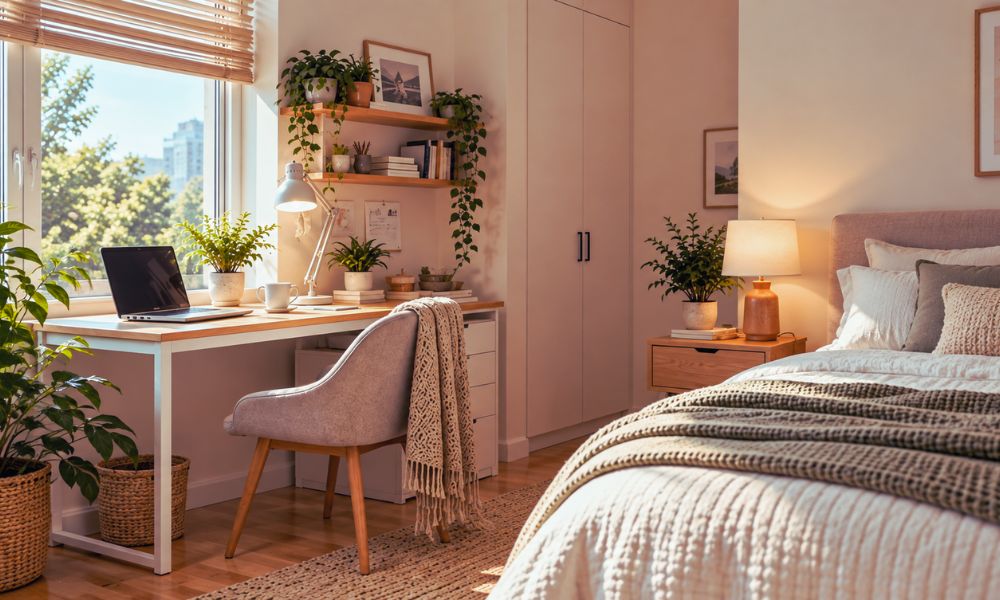
Working from home has become a normal part of the workweek for millions of Americans. Does that sound about right?
According to the American Time Use Survey for 2025, 35% of employed people in the U.S. worked some or all of their workday at home on days when they worked.
The problem is that a large number of homes were never designed for that kind of lifestyle.
If you do not have a separate room for a Home Office, the bedroom often becomes the only place where a desk and computer can fit.
Such a solution can work perfectly well, but I would try from the start to physically and visually separate work from the bed.
The position of the desk, light from the monitor, and equipment that remains active during the night can affect the space where you are supposed to sleep.
How I Got the Idea to Write a Blog on This Topic

A few years ago, I had a client with a large bedroom and a perfectly decent desk. He worked with 3D visualizations and occasionally left a render running until morning.
Everything seemed harmless until he realized that he was waking up more tired than when he went to bed, and when we discovered that the reason was exactly what we mentioned above, both of us were, to put it mildly, surprised!
So, this week, for the blog we all read regularly (at least I hope we read it regularly), I will try to save you from a few bad purchases and perhaps help you sleep better.
As for the other thing people do in the bedroom, you will have to figure that out yourselves.
Let Us First Decide What Matters More in the Bedroom, Work or Sleep?

The only good answer to that question is both equally.
Without a stable job, it is hard to go to bed peacefully. Without enough sleep, you sit down at your computer the next morning with considerably less energy.
Medicine also gives us a good reason to be careful. The American National Heart, Lung, and Blood Institute recommends a cool, quiet, and dark bedroom, along with avoiding televisions and electronic devices before bed because their light can disrupt the sleep-wake cycle.
If a monitor is glowing two meters from your pillow or your work laptop stays open beside the bed, the room no longer has the same conditions it had before you brought work into it.
Opinions on the subject are also divided. Interestingly, in a Houzz discussion about a Home Office space in the main bedroom, I found the experience of one person whose partner’s monitor and keyboard sounds made it harder for them to sleep.
Other people in the same discussion had completely different experiences.
Here Are a Few Useful Tricks!
Let me give you a few things that can help, completely free of charge, just this time!
- Turn off everything that glows during the night. A monitor, charger, docking station, and computer often have small LED lights that we barely notice during the day. Once the room gets dark, the situation looks completely different. I would literally lie in bed one night and check what remains visible.
- Finish work before you go to bed. I do not mean only closing the laptop. Put away papers and headphones. Move the chair back into place. If the work area visually remains active, it becomes easier to keep thinking about work.
- If the computer has to run overnight, move it away from the bed. A render or backup can take hours. Fans and vibrations become much more noticeable once the apartment gets quiet. If the device can sit farther away from the head of the bed, I would check that before anything else.
- Separate work light from evening light. A bright desk lamp is useful while you sit at the desk. Before bed, I would use another, softer light. One lamp does not have to solve both needs.
- Keep the floor around the desk clear. Bags, extension cords, and boxes pile up very quickly. In a bedroom, I would try to keep everything that can fit under the desktop or inside one closed drawer.
One more trick I always recommend to my clients! The single most important thing. When you finish the workday, the room should look at least a little different than it did at nine in the morning.
How Would I Design a Home Office in a Bedroom
Now I will look at the situation from the perspective of my profession!
If you lie in bed and look directly at a monitor, keyboard, and office chair, the work area will visually occupy much more space than it actually does. For that reason, whenever the layout allows it, I would turn the desk toward a wall or place it sideways to a window.
The bed should remain the main element of the room. The Home Office should take up part of the space, but it should not take over the entire composition.
In a larger room, I like to use a shallow shelving unit as a divider. It can interrupt the direct view between the bed and the desk and still allow enough light through. Sometimes a curtain is enough. In other cases, a low cabinet makes sense.
The question I would ask myself is: what do you see first when you open your eyes?
If the answer is a large monitor, there is still some work to do.
In smaller rooms, I would choose a narrower desk and a less bulky chair. I often see people place a small desk against the wall and later buy an office chair that takes up half the walkway. That is why I always measure the space with the chair pulled out, not only with the chair tucked under the desk.
Another detail matters to me. If you have a window, I would rather place the desk sideways to it than directly in front of the bed. You get daylight for work that way, and the work area more easily stays outside the main visual axis of the room.
What Mistakes Have I Noticed?
The most common mistake I have noticed has nothing to do with the size of the room.
People try to create a “real office” inside a space that is still a bedroom.
They add a large desk. Then an office lamp, followed by shelves above the desk. After that comes a larger chair because the previous one was not comfortable enough.
In the end, the work area gains more visual weight than the bed.
I would do the opposite.
The second mistake is choosing the location based on an empty wall instead of the way people move through the room.
An empty wall looks logical until you realize that the wardrobe doors open right there. Or that the chair blocks the walkway when you pull it out.
That is why I often do one very simple thing in rooms like this. I mark the future desk on the floor or wall with masking tape and use the space for a few days as if the furniture were already there.
Such a test can reveal a problem much faster than a plan on a screen.
What Would I Do?
If I had to create a Home Office in my own bedroom, I would keep it as small as possible.
I would place the desk sideways in relation to the bed, and I would turn the monitor toward the wall. I would turn off everything that glows at night, and after work I would put away as much work equipment as the space allowed.
If the space serves work well during the day and feels like a bedroom again in the evening, I would consider the layout successful.
And yes, if you can look at something other than your inbox before bed, I would consider that an added bonus.